EU-Mercosur: a done deal, hanging in the balance
With Trump’s latest tariff salvo, Europe needs to find friends, fast. The EU is on the cusp of securing a free trade deal that could ‘Trump-proof’ Europe’s economy and kickstart the growth needed to compete with the likes of China, India and an increasingly unreliable US. The potential economic boon that’s been 25 years in the making is significant: the biggest in the world, this free trade deal would create a market of over 770m people and eliminate 50% of tariffs. That would save EU exporters some €4bn annually and represent a potential increase of €20-30bn in the value of exports to the EU from Mercosur.
But the EU-Mercosur deal could collapse like TTIP, or worse get bogged down in bureaucracy, like CETA. Powerful forces on the left and right of politics could scupper this. There’s a sense of real concern and urgency amongst European supporters: this week alone (2C May) see Council president Costa and a delegation of MEPs in Mercosur to talk up the deal – whose main audience are as much back in Europe as their South American interlocutors on the ground.
The context
The political will has grown slowly. It took 20 years to allow South American farmers access to the EU market. In 2019 the EU and Mercosur reached a political agreement on the deal’s ‘trade pillar’, covering trade in goods, services, public procurement, IP law, and sustainable development.
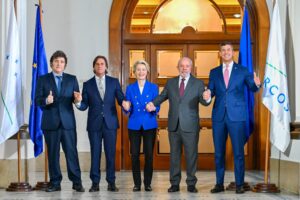
Credit: Ursula von der Leyen's X account
06 December 2024
Still, EU countries led by France rejected the deal over agricultural access to Europe. It was sent back to the Commission to renegotiate, which finally reached agreement with Mercosur in December 2024. Now President von der Leyen feels emboldened, and wouldn’t have travelled to Montevideo for a photoshoot with the four Mercosur leaders had she not been confident it could be ratified this year.
“Brazil is not just a close friend, it is a strategic partner for the EU – a global player and a key ally in promoting democracy, multilateralism and shaping a more just and sustainable world. Together, we are investing in trust, sustainability and an international order rooted in cooperation, not confrontation.”
António Costa
President of the European Council
Factor favouring ratification
‘Trump-proofing’ Europe: Trump’s decision to impose 20% tariffs on the EU is a game changer. It’s worth noting that the Mercosur countries all received the base rate of 10% that Trump imposed on the rest of the world. These are likely to be renegotiated successfully, not necessarily the case for the EU which is already considering retaliatory tariffs.
Diluting Beijing’s influence in South America: The EU sees China deeply entrenched in the Mercosur economies, not just in trade, but in investment, infrastructure and diplomacy. Although the deal won't substitute Europe for China as Mercosur’s major economic partner, from an EU perspective it is perceived as providing critical balance, reducing Beijing’s influence in South America.
Safeguards: In response to intense lobbying by Copa-Cogeca – the highly-influential EU-wide agriculture lobby group –repeating the mantra that EU farmers will be undercut by an influx of cheaper and lower quality South American meat, the European Commission has committed to a €1bn fund as “insurance” to cover farmers who can prove they have been adversely affected by the deal.
The existential threats to the deal
This notwithstanding, ratification of the deal in the EU faces potentially many more challenges than champions. We outline the major issues.
Splitting the deal
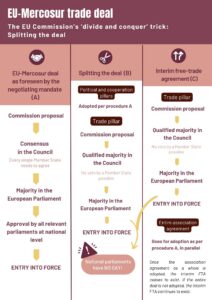
Free trade deals can have ‘mixed’ and ‘non-mixed’ elements. Mixed elements impact EU laws as well as the national laws of EU member states. Non-mixed elements impact EU law alone. Mixed elements of free trade deals therefore need approval by all 37 national and regional parliaments in the EU, while the non-mixed elements remain the sole preserve of the European Parliament and Council of the EU for ratification.
It is at the discretion of the College of Commissioners whether and how to split the deal into respective mixed and non-mixed parts. Von der Leyen will encourage the College to construct a deal that can be voted through quickly.
Credit: https://europeantradejustice.org/over-300-parliamentarians-reject-splitting-of-eu-mercosur-trade-deal/
At the last moment before it goes to the European Parliament and Council, the Commissioners will most likely decide to make the controversial parts an EU-level competency only.
Received wisdom suggests that this would mean agriculture would be reserved to the European Parliament and Council, with environmental and labour standards being considered ‘mixed’, and therefore requiring ratification by the 37 national and regional assemblies – as well as the EU-level institutions.
The so-called ‘legal scrubbing’ – translating the deal into legalese – will determine whether such a split is in accordance with EU law. This is expected to be completed by the end of the northern hemisphere summer. But as former MEP David Martin puts it, “any attempt to gerrymander a favourable division of competences might mean the agreement does not even survive legal scrubbing”.
How the deal is split has already been a bone of contention for NGOs like the European Trade Justice Coalition (ETJC), European Coordination Via Campesina and Greenpeace, all of which are existentially opposed to international free trade deals, primarily citing reasons of social justice. The ETJC argues splitting the deal removes the democratic voice of national and regional member states’ parliaments.
There will be intense pressure from national politicians, NGOs and special interest groups not to appear to be ramming the deal through without the public’s consent.
The real concern is that MEPs will be forced to vote on a deal where they know that the issues of climate and social justice will be rejected by national and regional assemblies anyway. A poorly thought-out ‘splitting’ of the deal could result in a legal challenge to the European Court of Justice, which could delay the whole process indefinitely.
Should the deal make it through legal scrubbing, it will be presented to parliament and the Council for ratification. Approval by these bodies is by no means a given, and requires strategic and consistent stakeholder engagement to get the deal over the line, as we detail in the following sections.
Problems in parliament
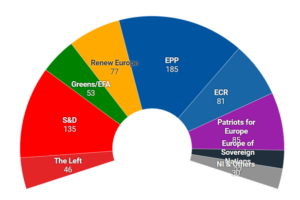
Ratification in the European Parliament is not a given by any means. Key to the deal passing in parliament is the support of the centrist European People’s Party (EPP) and Renew Europe groups. A simple majority of 361 MEPs is required. As the largest party, the EPP provides 188 votes. Renew Europe has 75 and are also in favour, giving a theoretical total of 263.
Lead Rapporteur Gabriel Mato (EPP) and Shadow Rapporteur Svenja Hahn (Renew) will attempt to persuade all their colleagues to vote in favour. But that is not a given, and there will be parliamentarians within these groups who break ranks to oppose the deal, for ideological or
local constituency reasons. Even if all EPP and Renew MEPs were to vote in favour (and they won’t), ratification would still require a further 98 votes from the remaining five political groups in the parliament, all of which have reasons to say no.
"I do not agree with those who say this is a done deal. These next few months will be key to ensuring the needs of European farmers are reflected." Maria Walsh MEP (EPP)
https://eu.boell.org/en/EP2024
The blocs to the left and right of the centrist supporters –shaded in yellow and pink in our graph – consist of parties that either are expressly opposed to or likely to vote against the deal. Opposition comes mainly from environmental concerns on the left, and solidarity with European farmers on the right.
Politics makes strange bedfellows, the saying goes, and this unnatural alliance of far-left and far-right parties is already being branded by the centrist EPP as “The ‘Mercosur Majority’”, which underscores how seriously the centrist parties view the threat to the deal from the political extremes in the parliament.
Lobbying of MEPs by anti-deal activists is progressing apace. Ireland’s Ciaran Mullooly for example – an MEP from the Renew group that supports the deal – is fronting an intense campaign lobbying MEPs “from across the EU” to vote against ratification.
The conundrums of the Council
The ratification vote in the Council (representing EU member-state governments) will be conducted on the basis of Ǫualified Majority Voting (ǪMV). ǪMV requires the assent of at least 15 member states, representing at least 65% of the EU population. Nine of the 27 member-states – including Germany, the EU’s most populous country – have already said they are in favour, meaning only another six are required to meet the member-state threshold.
But some of the unconfirmed and potentially opposed also represent some of the bigger EU economies, with political heft – and importantly, sizeable populations. Austria, France and Ireland have threatened to vote down the deal unless it includes stronger climate clauses. To fix this, the deal insists Mercosur countries must keep their Paris Climate commitments, but this may not be enough to assuage. The support of Italy, the Netherlands and Poland is still in the balance and up for grabs.
So a real possibility could emerge whereby the number of countries supporting the deal is enough, but falls short on the overall population threshold. This graphic illustrates this point dramatically: based on a scenario of only France, Italy, the Netherlands and Poland opposing, 23 out of the 27 EU member states approve, but represent just 59.5% of the population.
Hey, big farmer!
It’s not only the anti-deal politicians who are pulling out all the stops: MEPs and national governments will be on the receiving end of powerful lobbying campaigns by the influential Copa-Cogeca, the pan-European farmer lobby group, who criticise the deal for allowing ‘lower-quality’ South American meat to enter the EU market.
The widespread European farmer protests of 2024 still have politicians running scared. To be clear, the protests weren’t all about the Mercosur-EU trade deal – but what is important and relevant is the conflation of perceived anti-farmer policies in the political consciousness.
Campaign leaflets are being produced and circulated presenting the “facts” of concern for farmers: Mullooly’s campaign lays out the case for voting down ratification with factoids including claims of “low-grade cheap beef imported to the EU in huge quantities”, that the deal will result in a “mandatory cull” of national herds, and in “importing beef tied to deforestation in the Amazonian region”.
What’s to be done?
The deal can be saved. Reassurance and personal engagement are key. As is fighting mis- and disinformation with clear facts, figures and focus.
For example, the question of ‘quality’ is countered by the fact that the EU already has inspectors on the ground in Mercosur countries and has in place a strict certification procedure for ensuring which producers are granted access to the EU market. Europe will not be “inundated by cheap meat”: the quotas for beef and poultry are respectively of 99,000 tonnes (tariffed at 7.5%) and 180,000 tonnes (duty-free), phased in over five years. As mentioned, the European Commission has already committed to a €1bn fund to support any farmers who can demonstrate they have been adversely affected by the deal.
But concerted and urgent action is required. This means consistent and continued engagement of key political stakeholders. It means building alliances with the European sectors, industries and major companies that support the deal and will benefit from it. It means telling the story of the European growth and jobs that the deal will deliver. The story of a rising tide that floats all boats.
Read more