
EUDR: what the latest developments mean for trade
The EU Deforestation Regulation isn’t a distant policy – with a start date of 30 December 2025 just months away, it already impacting global supply chains & models. Four countries have been blacklisted, and Brazil & Argentina have been labelled as ‘standard risk’ – while Uruguay is the only Mercosur country ranked as ‘low’. Other recent developments in its rollout are adding to the complexity. The truth is that most businesses are unprepared for the challenges it is set to bring.
Time is of the essence
 Businesses and sectors exporting to the EU may have been lulled into a sense of complacency by the one-year suspension of the regulation announced last year, chalking this up as a ‘win’. But that delay probably had more to do with the EU giving itself breathing space to get its house in order prior to the new rules coming into force rather than any ostensible concession to non-EU countries.
What's new and what does it mean?
In addition to the publication of the initial country classification, three further developments are significant for countries exporting to the EU: the publication of the competent inspection authorities; the update of the Guidelines C FAǪ; and not least, a recent public consultation on the potential expansion of the scope and scale of the regulation.
1. A game of Russian roulette for ports
The recent publication of the list of the 27 competent authorities raises concerns about the even application of the regulation across different EU member states. Several large EU economies are home to Europe’s major importing ports, and will be critical. Rotterdam in the Netherlands, Germany’s Hamburg, Le Havre and Marseille in France, Portugal’s Sines, Valencia in Spain and Italy’s Genoa are just a handful of examples.
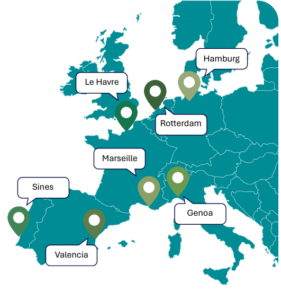
As each member state has designated its own competent authority, there is wide disparity and discrepancy in where the inspection competencies lie. Take Germany, where this responsibility falls to the Federal Office for Agriculture and Food; in Spain, rather, the responsibility is shared by the Directorate-General of Biodiversity, Forests and Desertification under the Ministry for the Ecological Transition C the Demographic Challenge (MITECO), and its numerous regional authorities. Countries like France and Portugal apply a multi-authority approach: France assigning responsibility to two ministries –Agriculture, and Ecological Transition – while Portugal, to the Directorate-General for Food and Veterinary Affairs and the Institute for Nature Conservation and Forests (ICNF).
Why this matters
This unaligned, disparate approach raises the risk of fragmented, uneven and unfair application of the rules across EU countries. This will not only add significant bureaucratic, administrative and cost burdens to exporters, but the very real possibility of legal and compliance risks.
This potential ‘organised chaos’ could lead to chokepoints in the European port system, creating a backlog of supply, and potentially even shutting down ports for extended periods. The resolution of this would be slow and arduous: government action to resolve this problem may have to include legislation to extend port capacity, a lengthy and political process.
EU productive sectors relying on these imports to meet their supply chain commitments won’t want to wait that long. They may baulk at the unpredictability and disruption and migrate en masse to what they perceive as safer-haven suppliers.
2. New playbook, old problems
At the same time the Commission released updated guidelines and FAǪs on 15 April 2025, after its first edition from November 2024 was widely criticised as inadequate and unfit for purpose. Whether this second edition will succeed in easing the concerns and anxieties of international trading partners remains uncertain. Our assessment of the updated documents remains cautious, as they provide only modest improvements.
Some clarifications have been introduced, notably allowing due-diligence statements to be submitted annually rather than for each shipment, and enabling large companies to reference existing statements when reimporting goods previously placed on the EU market. But these adjustments do little to resolve the broader challenges.
Why this matters
Critical gaps, ambiguities, and areas open to interpretation persist, depriving third-country exporters of the legal certainty and business predictability they urgently need. In an era of heightened geopolitical tension and volatile trade dynamics, such uncertainty presents a serious risk to business continuity, market access, and competitiveness.
3. Beyond forests: is your sector next?
Somewhat less well known was the recent public consultation carried out by the Institute for European Environmental Policy (IEEP) on behalf of the European Commission on the potential extension of the EUDR, submissions to which closed on 28 February 2025.
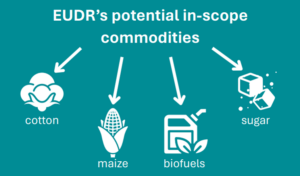
The consultation notably sought perspectives on two key questions. First, the inclusion of other productive sectors not currently within the scope of the legislation, including cotton, maize, biofuels and sugar. And second, changing the provisions of the law to expand to other ecosystems, including non-forest, “other wooded land and other ecosystems” such as savannahs and native grasslands.
Why this matters
The European Commission has faced sharp criticism from environmental groups and NGOs over a perceived retreat on and watering down of many of the Green Deal provisions, following the strong swing to the populist right in the last European elections. Expansion of the EUDR could be an easy ‘win’ for the Commission as the burden of an expanded scope would fall mainly on non-EU third countries, and would chime with European protectionist forces.
What’s to be done?
The path forward demands sustained engagement, strategic advocacy, and flexibility. While the four countries recently blacklisted is in keeping with the idea of only including – to begin with – those under EU or UN sanctions, this provides no guarantees for the future for major commodity exporters.
Organisations must remain proactive, engaged with stakeholders while pressing for a clearer and more consistent approach to the application of the rules. The road is challenging, but with persistent, coordinated efforts, it is possible to steer the EU towards greater clarity, pragmatism, and balance.