Malaysia-EU relationship: unlocking new opportunities
In an uncertain world where old trade truisms can no longer be taken for granted, the EU is eagerly seeking reliable partnerships across the globe. This is unlocking business opportunities for Malaysian companies seeking to take advantage of the current turbocharging of the Malaysia-EU relationship.
What’s happening and why now?
Malaysia-EU relations are entering a renewed phase of trade and investment engagement.
Negotiations for a Malaysia-EU Free Trade Agreement were paused in 2012,4 but resumed in 2025. The relaunch comes at a time of significant geopolitical and economic realignment.
Both parties announced an ambitious plan to conclude an FTA by October 2027, the 50th anniversary of EU-ASEAN relations: a politically symbolic target date that creates real urgency for both.
The EU is looking to de-risk supply chains and diversify partnerships: Malaysia’s strengths in semiconductors, clean technology, digital services and critical minerals and resource processing make it a compelling partner in the context of the EU’s economic-security agenda.
Malaysia is also actively diversifying to strengthen its own resilience and optionality. The EU's rules-based stability makes it hugely attractive as a reliable trading alternative, particularly in light of US unpredictability.
The comprehensive FT will focus on easing customs and trade facilitation, trade remedies, and reducing technical barriers to trade. Both seek to deepen cooperation also in other high-value sectors including digital trade, clean energy, critical raw materials, infrastructure, professional services, government procurement, and investments. In the sensitive agriculture sector, rules of origin, sanitary and phytosanitary measures, sustainable food systems represent three core areas of the agreement being negotiated.
Why the EU and Malaysia matter to each other
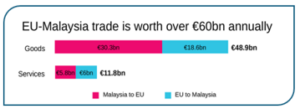
→ Malaysia is one of the EU’s most important trading partners in Southeast Asia, with bilateral goods trade reaching €48.9bn in 2025 and services trade amounting to €11.8bn in 2024.
→ The EU’s relationship with Malaysia is being reshaped by the need to diversify supply chains, strengthen economic security and build more resilient partnerships across the Indo-Pacific.
→ Malaysia’s role as a major electronics manufacturing hub makes it particularly relevant to Europe’s efforts to reduce supply-chain vulnerabilities in semiconductors, advanced manufacturing and industrial technologies – and makes the EU an attractive and expanding market for its electronics sector.
→ Malaysia and the EU are commercially attractive partners for one another: deeply integrated into Asian production networks, Malaysia is also seeking greater diversification of export markets, investment sources and technology partnerships.
→ For Malaysian businesses, closer EU ties also bring a regulatory dimension: companies that prepare early for EU requirements on sustainability, deforestation, carbon, product standards and data will be better positioned to access European markets and partnerships.
What are the key areas of opportunity – and risk?
The emerging Malaysia-EU FTA agenda creates opportunities across sectors where Malaysia already has developed strengths and where Europe is actively seeking reliable partners – but challenges persist.
| Digital trade & fintech | Clean tech & critical minerals | Electronics & semiconductors | |||
| Sustainable ag and food systems | Foreign Direct Investment | Infrastructure & professional services |